
Allegations that police planted five firearms in Maloney Gardens have intensified scrutiny of the ongoing security operation, with residents claiming to possess CCTV evidence and the police commissioner demanding its production.
The Maloney firearms discovery has triggered a growing dispute between residents and the Trinidad and Tobago Police Service (TTPS), with allegations that officers planted weapons during a security operation now placing the conduct of the exercise under increased public scrutiny.
Police Commissioner Allister Guevarro has challenged residents who claim the five firearms recovered in Maloney Gardens were deliberately planted, demanding that they produce what they say is video evidence of the alleged incident. He said more than 24 hours after the accusations surfaced, no footage had been presented to investigators, the police service or the media.
The controversy follows the recovery of five firearms in a fig patch near Building 20 in Maloney Gardens on Tuesday, November 17, while the community remained under a security lockdown imposed under the Special Operations Act, 2026.
Residents allege weapons were planted
The allegations emerged after residents told the Trinidad and Tobago Guardian that surveillance cameras had allegedly captured soldiers entering the area where the weapons were subsequently discovered on the night before the police recovery.
According to the residents, the footage showed soldiers carrying a bag into the vicinity, with police later returning to retrieve a bag containing firearms.
Some residents also claimed that police and soldiers had searched the same general area on three previous occasions without finding weapons.
Despite saying that the recordings would support their claims, residents declined to provide the footage to reporters, indicating that it would be released at a later date.
A community elder, who said he had lived in Maloney for more than 30 years, maintained that the firearms had been placed there and questioned why residents were being subjected to the security operation.
Other residents disputed suggestions that heavily armed criminal gangs were operating within the housing development, pointing to what they described as a longstanding peace agreement involving Buildings 17, 18, 19 and 20.
They argued that the community should not be collectively treated as a criminal stronghold because of the actions of individuals.
These accounts represent residents’ allegations and have not been independently verified.
Commissioner challenges residents to produce footage
In a video statement, Guevarro directly addressed the accusations, saying he had immediately called on those making the claims to provide the recordings they said they possessed.
“When these allegations first emerged, I immediately called upon those making the claims to do the simple and responsible thing: produce the video recording, which all you say that all you have. Twenty-four hours later, crickets,” the commissioner said.
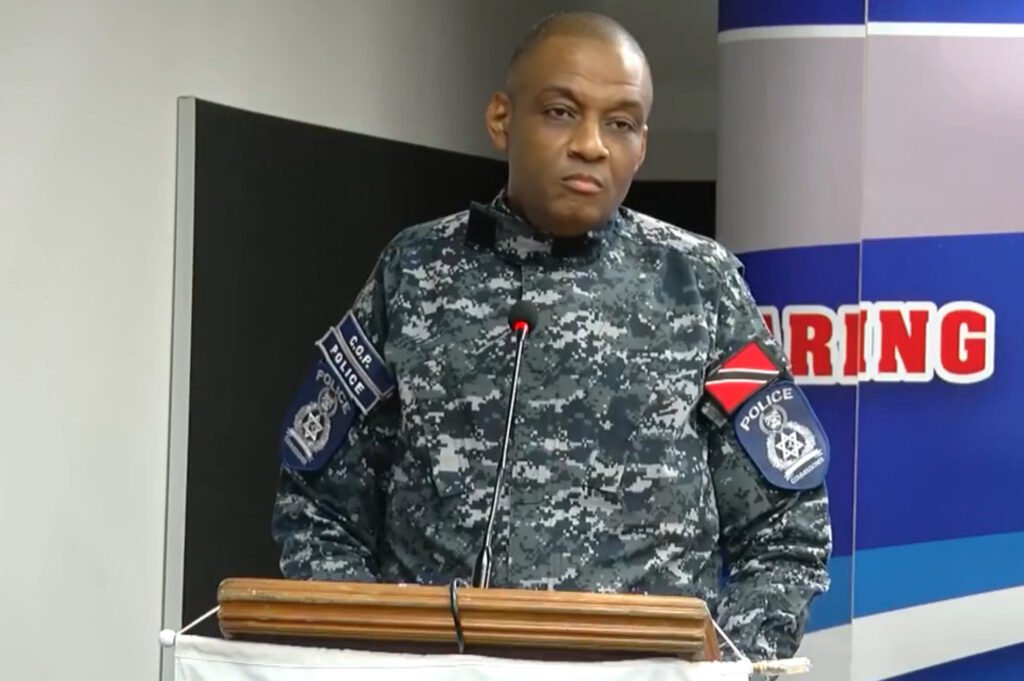
He maintained that despite the public discussion and speculation surrounding the discovery, no such recording had been presented to him, the TTPS or the media.
The commissioner also said investigators had been appointed to examine the allegations.
His position places the responsibility on residents claiming to possess evidence to make it available to investigators, particularly because the alleged footage could help establish who entered the area and what occurred before the weapons were recovered.
However, the absence of publicly produced footage does not independently establish what happened at the location. The circumstances surrounding the discovery remain a matter for investigation.
Maloney firearms discovery raises questions about weapons recovery
The official police account provides another important part of the developing story.
According to information published by TTT News, officers conducting an intelligence-led operation on November 17 proceeded to a bushy area south of Flamingo Boulevard, near Building 20.
With assistance from the Police Canine Unit, officers reportedly located two bags concealed beneath a banana tree and covered with a sheet of galvanise.
The police account listed five firearms: a Taurus pistol, a VR80 semi-automatic shotgun, a homemade shotgun, a silver-and-black revolver and an MK-2 FGC-9 firearm.
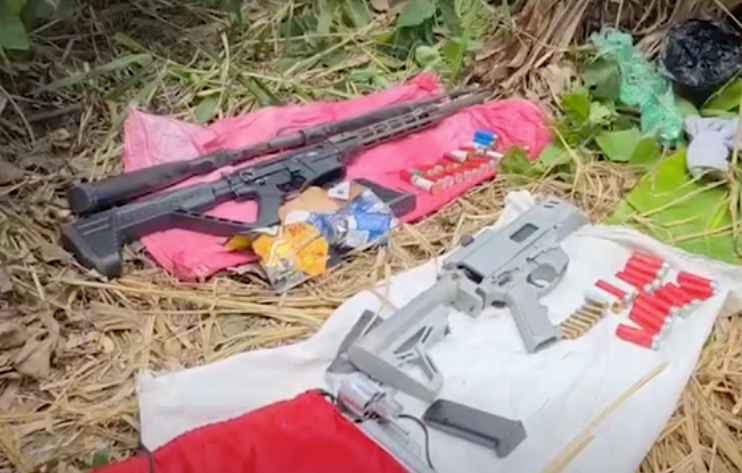
The recovery also included 49 live rounds of ammunition, comprising eight rounds of .44 ammunition, 39 12-gauge cartridges and two rounds of 9mm ammunition. Police also reported finding a spent shotgun cartridge and several firearm magazines.
The Northern North Division Crime Scene Investigation Unit subsequently processed the scene.
However, media descriptions of the weapons have not been entirely consistent.
The Trinidad and Tobago Guardian described the recovered items as including an AR-15 rifle, a shotgun, a revolver, a pistol and an automatic firearm. The Trinidad Express also reported the discovery of an AR-15 rifle alongside other firearms.
The official TTT News inventory, meanwhile, identified an MK-2 FGC-9 firearm rather than an AR-15.
This difference in the descriptions warrants clarification from the police, particularly regarding the precise identification of each firearm.
It does not, on its own, establish that the recovery was improperly conducted. Nevertheless, accurate identification of the weapons is important in any investigation involving their origin, possession and potential connection to criminal activity.
The lockdown predates the weapons discovery
Another important consideration is the timeline of the security operation.
The Maloney Buildings housing development was declared a closed area on November 10, seven days before the five firearms were recovered.
The lockdown followed a series of security concerns and violent incidents that prompted authorities to intensify operations in and around the community.
The distinction is significant.
The November 17 weapons discovery could not have been the original reason for imposing the November 10 closure, although police may rely on subsequent discoveries as further evidence supporting the need for continued security measures.
Residents, however, have described the restrictions as oppressive and disruptive, arguing that ordinary citizens are bearing the consequences of the operation.
The Guardian also reported complaints about restrictions affecting access to homes, businesses and family members. One resident, hair and nail technician Tabita Alleyne, estimated that she had lost more than TT$3,000 in earnings because customers could not access her business.
An elderly resident also raised concerns about access for people requiring assistance, including ambulance services.
These complaints add another dimension to the controversy: the balance between the state’s responsibility to address serious security threats and the rights and everyday needs of residents living within a closed community.
What evidence could establish what happened?
At the centre of the dispute is a question that neither the residents’ allegations nor the commissioner’s public challenge can independently resolve: who placed the firearms at the location before police recovered them?
If the alleged surveillance footage exists, investigators would need to establish its authenticity, date, time, location and continuity.
The recordings would also need to be examined in context. Images of individuals carrying a bag would not necessarily establish what the bag contained or prove that the firearms were planted.
Other evidence could help establish the circumstances surrounding the discovery, including:
- CCTV recordings: Footage from cameras covering the area before and during the recovery.
- Operational records: Police and military deployment logs, search records and reports documenting earlier searches.
- Crime-scene documentation: Photographs, video recordings and records showing the location and condition in which the bags were discovered.
- Forensic examination: Fingerprint and DNA testing, where suitable, together with examinations of the firearms and ammunition.
- Chain of custody: Documentation showing how the weapons were recovered, packaged, secured and transferred for examination.
- Witness accounts: Statements from officers, soldiers and residents who may have observed activity in the vicinity.
These are investigative avenues, not findings that such evidence has already been obtained or that any irregularity has occurred.
Public confidence depends on a transparent investigation
The competing accounts have created a situation in which public confidence depends heavily on the quality and transparency of the investigation.
The police have a responsibility to investigate the allegations that officers may have improperly handled or planted evidence. Equally, residents who claim to possess recordings supporting serious accusations should make them available to the appropriate authorities so they can be properly assessed.
The commissioner has said investigators are examining the allegations, but the public will ultimately need more than competing statements to understand what happened.
The firearms recovery itself also requires proper documentation, including clear identification of the weapons, their forensic examination and any evidence linking them to individuals or criminal activity.
As of November 20, no publicly reported arrest or charge had been identified in connection with the five firearms, and the alleged surveillance footage had not been made public.
For now, the claims that the weapons were planted remain unproven, while the police account of the recovery remains subject to the ongoing investigation.
The central issue is no longer simply whether five firearms were found in Maloney Gardens. It is whether the available evidence can establish how they got there, who placed them there and whether the recovery was conducted in a manner that withstands independent scrutiny.