
Isaias strengthened into the Atlantic season’s first hurricane. Landfall is forecast along the northern Gulf Coast this weekend.
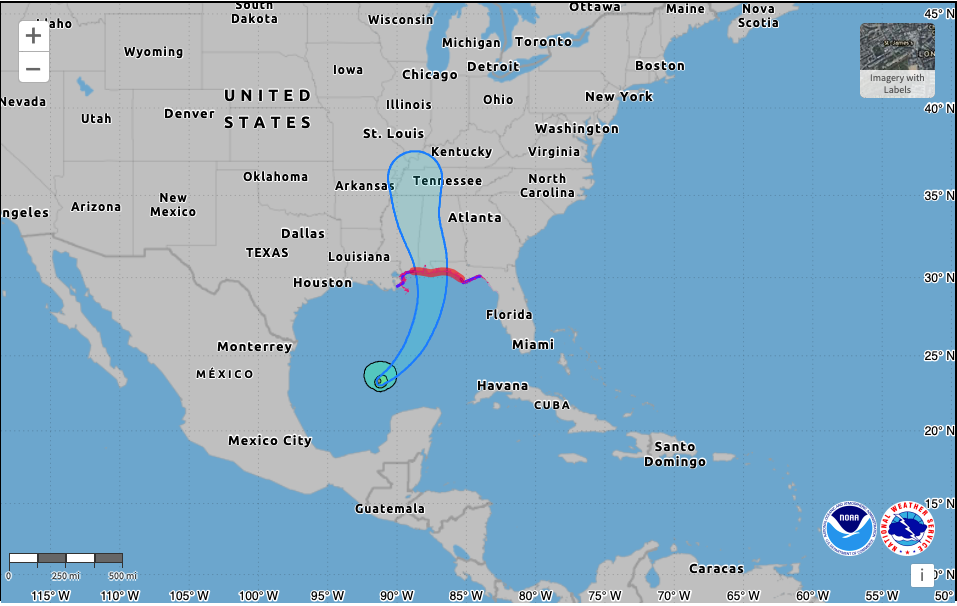
Isaias strengthened into a hurricane late Wednesday, becoming the first hurricane of the 2026 Atlantic season. The National Hurricane Center said the storm had maximum sustained winds of 75 mph and was about 460 miles southwest of the mouth of the Mississippi River. It is forecast to pass north of Mexico’s Yucatan Peninsula on Thursday and make landfall along the northern Gulf Coast late Friday or early Saturday. The most likely landfall area runs from the western Florida Panhandle to the Mississippi coast.
Forecasters expect Isaias to strengthen quickly over warm Gulf waters, reaching at least Category 2 by Thursday night, according to The Weather Channel. Wind shear is expected to increase as the storm moves north and could weaken it before landfall. The most likely strength at landfall is currently Category 2, though the forecast could change.
A hurricane warning is in effect from Ocean Springs, Mississippi, to the Bay and Gulf county line in Florida. A tropical storm warning covers the coast from south of New Orleans to Ocean Springs, and from the Bay and Gulf county line to the Aucilla River in Florida. A storm surge warning extends from the mouth of the Mississippi River along the Florida coast. Florida Gov. Ron DeSantis declared a state of emergency for 25 counties, and Alabama Gov. Kay Ivey did the same for 40 counties.
Forecasters say damaging winds could begin as early as midday Friday and last into Saturday morning. Those winds could cause power outages lasting hours to several days. Rainfall of 3 to 7 inches is expected near the coast, with isolated totals up to 10 inches. Isolated tornadoes are also possible. The storm’s remnants are forecast to spread heavy rain across the Southeast, the Appalachians, the Ohio Valley and the mid-Atlantic this weekend, raising the risk of flash flooding.
Isaias reached hurricane strength on the latest date in 111 years for the Atlantic season’s first hurricane, tying a record set Oct. 8, 1905, according to NOAA data cited by CBS News. The season, which runs from June 1 through Nov. 30, has been unusually quiet, and meteorologists have linked this to a strong El Niño. The first hurricane of a typical season forms in early to mid-August. Three earlier named storms this year, Arthur, Bertha and Edouard, struck the Gulf Coast as tropical storms.
Information for this report came from CBS News, The Weather Channel and the National Hurricane Center.