
SpaceX caught a returning Starship with its launch tower Saturday. The Super Heavy booster exploded over the Gulf.
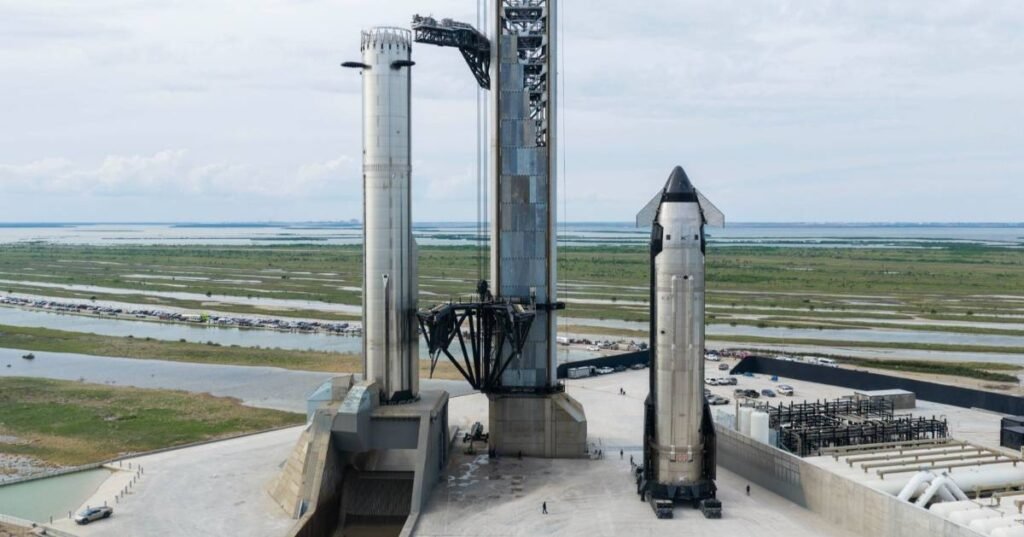
SpaceX completed the first Starship catch on Saturday, when giant mechanical arms on its Texas launch tower grabbed the returning spacecraft out of the air, although the company’s Super Heavy booster was lost in an explosion over the Gulf of Mexico.
The milestone came about 22 hours after Starship launched Friday from SpaceX’s Starbase facility, according to Fox Business. The spacecraft deployed 26 Starlink satellites and completed 14 orbits of Earth before returning to the launch site.
How the Starship catch worked
The tower’s arms, known as Mechazilla, caught the spacecraft as it descended toward the pad at Starbase, Fox Business reported. SpaceX had previously caught its Super Heavy booster three times, but had not caught the Starship upper stage itself. Fox Business described the flight as the 15th Starship test flight, and a SpaceX video caption it published identified the vehicle as Starship 42.
The catch is a step toward SpaceX’s goal of a fully reusable rocket system intended to cut launch costs and support more frequent space missions, according to Fox Business.
Booster lost over the Gulf
SpaceX fell short of its aim of recovering both stages. The Super Heavy booster’s engines shut down prematurely during its descent on Friday, prompting a diversion, and the booster exploded over the Gulf of Mexico, Fox Business reported. Engineers are investigating the cause, the outlet said.
Reaction
NASA Administrator Jared Isaacman praised the catch on X, writing that it was almost magic, Fox Business reported. Walter Isaacson, Elon Musk’s biographer, wrote on X that the catch was a bigger deal for humanity than most people could imagine. He recalled the reaction of engineers in a Starbase conference room in December 2020, when Musk first suggested the arms could catch a returning Starship.
Why the Starship catch matters
NASA is relying on Starship technology for its Artemis program, which aims to return astronauts to the moon, while Musk hopes to eventually use the spacecraft for missions to Mars, Fox Business reported. Fox Business said the catch advances the company’s reusable-rocket ambitions.
Starship is also central to SpaceX’s Starlink business. The flight deployed 26 Starlink satellites, according to Fox Business, which illustrates the vehicle’s role as a launcher for the company’s satellite internet network as well as a deep-space ship.
Timeline of the flight
Starship lifted off Friday from Starbase, Texas. The Super Heavy booster’s engines shut down early during its descent that day, and the booster was diverted and exploded over the Gulf of Mexico, according to Fox Business. Over the following 22 hours, the spacecraft deployed 26 Starlink satellites and completed 14 orbits before returning to Starbase, where the tower arms caught it on Saturday, Nov. 14.

What remains unconfirmed
Aurax News has not independently confirmed the flight number or the account of the booster failure, which come from Fox Business and a SpaceX video caption it published. SpaceX has not said when it expects to fly Starship again or how the booster failure may affect the schedule.
Booster catches so far
The Starship catch builds on SpaceX’s work with its Super Heavy booster. The company has caught that first stage three times, according to Fox Business. Friday’s booster failure shows that recovery of both stages on a single flight remains unproven.
The engine shutdown that sent the booster off course is the main open question from the flight. Fox Business reported that engineers are investigating, and SpaceX has not published an explanation. Until it does, it is not clear whether the problem is specific to this booster or a design issue that could affect future flights.
What happens next
Engineers are investigating the booster failure, according to Fox Business. SpaceX has not published a timeline for its next test flight.
Sources:Fox Business’s Nov. 14, 2026 report