
|
Getting your Trinity Audio player ready...
|
Iranian President Masoud Pezeshkian rejected U.S. pressure at the U.N. He said Tehran remains open to diplomacy talks.
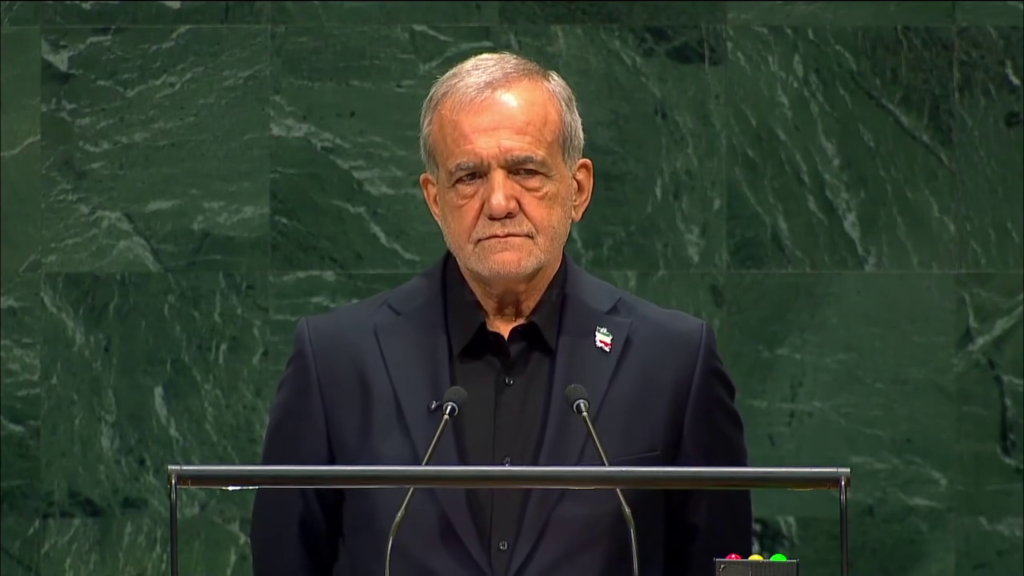
Iranian President Masoud Pezeshkian told the United Nations on Wednesday that Iran would not surrender to U.S. pressure while remaining open to negotiations and diplomacy to end the conflict with Washington. His address came one day after U.S. President Donald Trump warned that he could escalate the war if an agreement was not reached.
Pezeshkian accused the United States and Israel of attacking Iranian civilians and infrastructure, while presenting Iran’s military response as defensive. He also rejected accusations that Tehran was responsible for terrorism and said Iran had the right to defend itself without seeking permission from other countries. Reuters reported that the U.S. delegation left the General Assembly at the start of his address.
The Iranian president also addressed his country’s nuclear program, saying Tehran does not seek nuclear weapons but will not abandon what he described as its right to peaceful nuclear technology. He argued that nuclear energy has applications in medicine, agriculture and electricity generation.
The Strait of Hormuz was another central issue in Pezeshkian’s remarks. He said Iran could not accept a situation in which other countries benefit from the strategic waterway while Iran’s access is restricted, and argued that expanding military activity around the strait would not create security. The waterway has become a major focus of the conflict because of its importance to global energy shipments.
Pezeshkian also criticized Israel’s actions in Gaza and called for greater attention to the Palestinian issue, arguing that lasting regional peace requires what he described as justice for Palestinians. He said regional security should be addressed by countries in the region rather than being determined by outside powers.
Despite the confrontational language, Pezeshkian repeatedly said Iran was prepared to return to negotiations. He told the Assembly that Tehran was ready for dialogue and diplomacy but would not accept negotiations conducted under what he described as the language of force. His speech followed renewed U.S.-Iranian diplomatic contacts in New York, including a meeting between senior representatives from both sides on Tuesday.
Sources: Transcript of President Masoud Pezeshkian’s U.N. address, Reuters, Associated Press and The Guardian.