
The renewed Invaders Bay development promises major investment, hotels and jobs, but its history of procurement controversy and legal challenges puts transparency and public accountability back in focus.
PORT OF SPAIN, Trinidad and Tobago — A development project that has attracted years of controversy over the management of state-owned land, government procurement and public disclosure has returned to the national spotlight, following the announcement of a proposed TT$1.75 billion mixed-use development at Invaders Bay.
Prime Minister Kamla Persad-Bissessar officially turned the sod on November 20, 2026, for the first phase of the project, which is being undertaken through a partnership between the Urban Development Corporation of Trinidad and Tobago Limited (UDeCOTT) and Mouttet Capital Limited.
The announcement represents a significant step in the latest attempt to transform the waterfront property along the Audrey Jeffers Highway into a major commercial, residential, hospitality and recreational district.
However, the renewed development plans also bring attention back to a history of legal disputes, questions about procurement procedures and concerns raised by construction industry representatives and public accountability advocate Afra Raymond.
At the centre of the controversy is a fundamental public interest question: how should valuable state-owned land be developed, leased and allocated to private interests, and what information should be available to citizens about the decisions involved?
A valuable stretch of state-owned land
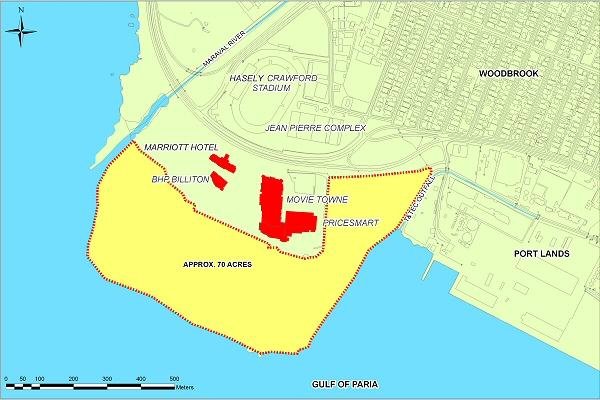
Invaders Bay, located south of the Audrey Jeffers Highway in the vicinity of MovieTowne, forms part of a substantial reclaimed coastal area in western Port of Spain.
According to UDeCOTT, the development occupies approximately 24 hectares of reclaimed land. The existing commercial and entertainment facilities include the MovieTowne complex, PriceSmart, the Courtyard by Marriott Hotel and the BHP Billiton corporate building.
The corporation’s development vision extends considerably beyond the existing commercial establishments.
Its project description identifies opportunities for additional office and retail developments, hotels, conference facilities, residential buildings, recreational parks, a marina and a ferry terminal.
It also identifies a proposed Trinidad and Tobago Global Financial Centre, additional reclamation along the western foreshore and a boardwalk connecting Invaders Bay to central Port of Spain.
UDeCOTT describes the project as ongoing on its official website.
The Invaders Bay development therefore involves more than the construction of individual commercial buildings. It represents a wider proposal to reshape a significant section of the capital city’s waterfront.
The original procurement controversy
The controversy surrounding Invaders Bay dates back to 2011, when the then Ministry of Planning and the Economy invited expressions of interest for the development of approximately 70 acres of state land south of MovieTowne.
The initiative was presented through a Request for Proposals (RFP), inviting prospective developers to submit competitive design-and-build proposals.
However, the process attracted objections from the Joint Consultative Council for the Construction Industry (JCC), which questioned whether the ministry had the authority to conduct the selection process outside the procedures of the Central Tenders Board.
The JCC, whose president at the time was Afra Raymond, argued that the process amounted to a public tender and should have been conducted under the applicable Central Tenders Board legislation.
The council also questioned the transparency of the arrangements, including how developers would be selected and how lease arrangements for the state-owned property would be determined.
The dispute escalated after the ministry maintained that it had received legal advice from the Office of the Attorney General and its own legal unit indicating that the RFP process did not have to comply with the Central Tenders Board Act.
The ministry subsequently declined to provide the legal opinions when the JCC requested access to them under the Freedom of Information Act.
The disagreement eventually moved into the courts.
A landmark Freedom of Information dispute
In July 2014, High Court Justice Frank Seepersad ruled in favour of the JCC in its application seeking disclosure of information relating to the legal advice behind the Invaders Bay procurement process.
The court found that the council was entitled to the requested information under the Freedom of Information Act, subject to applicable restrictions and redactions.
The government appealed the ruling, maintaining that the legal opinions were protected by legal professional privilege.
The dispute reached the Court of Appeal, which delivered its judgment on October 28, 2016.
The Court of Appeal dismissed the minister’s appeal and upheld the central principle that disclosure of the legal advice was justified in the public interest.
In its reasoning, the court distinguished between legal advice involving the private affairs of an individual and advice given by public officers concerning a major development involving valuable state property and substantial public expenditure.
The judgment emphasised that transparency and accountability were particularly important in the latter circumstances.
The court also considered the significance of the Central Tenders Board’s procedures, which are intended to promote transparency and fairness in the selection of bidders.
Importantly, the judgment did not establish that the entire Invaders Bay development was unlawful. It concerned the refusal to disclose information and the public interest in examining the legal basis for the procurement arrangements.
The order required the relevant legal advice and information about the date on which it was requested to be provided.
The case remains an important reference point in discussions about transparency in public administration and the disposal or development of state property.
Afra Raymond’s continuing scrutiny
Afra Raymond’s involvement in the Invaders Bay controversy extended beyond the original court proceedings.
Through his public commentary and published material, Raymond continued to examine the project’s history, the proposed arrangements and the implications of the legal decisions.
His December 2016 articles revisited the development proposals and the questions surrounding the selection of private-sector developers.
One of the issues he highlighted was the value of the land and the scale of the proposed development.
Raymond cited a 2012 valuation of approximately TT$1.28 billion for the 70 acres of undeveloped land.
He also discussed earlier proposals involving commercial and residential developments, hotels, entertainment facilities, cruise-related facilities and a marina.
These historical proposals should be distinguished from the current development programme. They do not, by themselves, establish that the earlier projects were constructed, awarded or implemented.
Nevertheless, Raymond’s scrutiny helped keep attention on the broader question of how major public assets are managed and how decisions involving private investment are made.
UDeCOTT’s renewed development process
The more recent development process has placed UDeCOTT at the centre of the project.
In an Expression of Interest document published in January 2025, the corporation invited private-sector entities to express interest in leasing land and constructing buildings consistent with its conceptual development plan.
The document divided the land into 13 parcels and identified several intended development categories, including:
- Office and commercial spaces.
- Recreational and entertainment facilities.
- Hotel accommodation.
- Conference and convention facilities.
- High-rise residential units.
- A marina.
UDeCOTT also stated that infrastructure was available at the site, including potable water, sewerage, electricity, communications, drainage and paved access roads.
Interested companies were required to submit an introduction letter, company profile and general overview of their proposed development.
The deadline for submissions was February 14, 2025.
The corporation reserved the right to shortlist interested entities based on its assessment of the responses received.
The Expression of Interest therefore established a framework for attracting private-sector participation in the development.
However, the publicly available notice does not, on its own, establish how many companies submitted proposals, which entities were shortlisted, what evaluation criteria were ultimately applied or how the current development partnership emerged from that process.
Those details are important to understanding the transition from an invitation for private-sector interest to the announcement of a specific development partnership.
What the latest TT$1.75 billion proposal involves
The November 20, 2026, sod-turning ceremony introduced the latest phase of the Invaders Bay development.
According to statements made at the ceremony and subsequent reporting, Mouttet Capital chairman Christian Mouttet outlined a proposed development covering approximately 590,000 square feet.
The first phase is expected to include a 135-room AC Hotel by Marriott, conference facilities, a cultural centre, office buildings, high-rise residential units, retail outlets and food and beverage businesses.
The first phase is expected to require an investment exceeding TT$620 million, with construction anticipated to begin during the second half of 2027.
Mouttet indicated that the overall development would involve approximately TT$1.3 billion in development costs, together with another TT$450 million in internal outfitting costs.
This would bring the projected investment over the life of the development to approximately TT$1.75 billion.
The Prime Minister described the initiative as an important component of the government’s economic revitalisation programme, with the potential to create employment and attract private investment.
Government projections include approximately 1,405 job opportunities across construction, hospitality, retail and other sectors, according to TTT News and subsequent reporting.
These figures represent projected employment opportunities rather than confirmed jobs already created.
The distinction is important, particularly because the main construction phase is not expected to begin until 2027.

Public money, procurement and the questions that remain
Although the latest announcement presents an ambitious investment opportunity, the project’s history makes transparency an important part of any assessment of its public value.
Several questions deserve clear answers.
First, what were the results of UDeCOTT’s 2025 Expression of Interest exercise?
The public notice invited private companies to submit proposals for 13 parcels of land. The selection process and the relationship between those submissions and the current partnership should be explained.
Second, what are the precise financial and contractual arrangements between UDeCOTT and Mouttet Capital?
The announced investment figure of TT$1.75 billion describes the projected development expenditure. It does not, by itself, explain the land lease arrangements, the allocation of development rights, the financial obligations of each partner or the distribution of commercial benefits.
Third, what safeguards will ensure that the public receives appropriate value from the use of the state-owned property?
The value of the land, the duration and conditions of any lease, the responsibilities of the private developer and the financial benefits accruing to the state are matters of legitimate public interest.
Fourth, what environmental, coastal and infrastructure assessments have been completed or are required for the proposed development?
Given the site’s reclaimed coastal location and the wider proposals for waterfront development, the public should be able to understand the applicable environmental approvals, drainage arrangements, traffic implications and infrastructure requirements.
Finally, what provisions will ensure that the development delivers lasting benefits beyond its commercial operations?
The announced employment projections are significant, but citizens will also want to know about local contractor participation, opportunities for small businesses, access to public recreational spaces and the long-term impact on Port of Spain.
These questions do not imply wrongdoing by UDeCOTT, Mouttet Capital or any other party. They identify areas where disclosure and independent scrutiny would help establish public confidence.
A new chapter, but accountability remains essential
Invaders Bay has been the subject of development ambitions for more than a decade.
The latest partnership between UDeCOTT and Mouttet Capital offers a renewed opportunity to advance a major waterfront development that could contribute to commercial activity, tourism, housing and employment.
However, the history of the project demonstrates why the management of state-owned land cannot be assessed solely through investment announcements, architectural plans or projected job figures.
The earlier legal dispute was not simply about whether development should take place. It raised fundamental questions about the procedures used by public authorities, access to information and the public’s ability to examine decisions involving valuable state assets.
As the project moves towards its anticipated construction phase in 2027, the publication of relevant agreements, procurement information, land lease arrangements and approval documents would provide a clearer picture of how the development is being undertaken.
The TT$1.75 billion vision may represent a major commercial opportunity for Trinidad and Tobago. Its ultimate public value, however, will depend not only on the investment delivered but also on the transparency of the arrangements, the benefits secured for citizens and the accountability of the institutions entrusted with managing the country’s assets.