
Florida researchers are using environmental DNA testing and high-tech prey decoys in an effort to detect and remove invasive Burmese pythons from the Everglades.
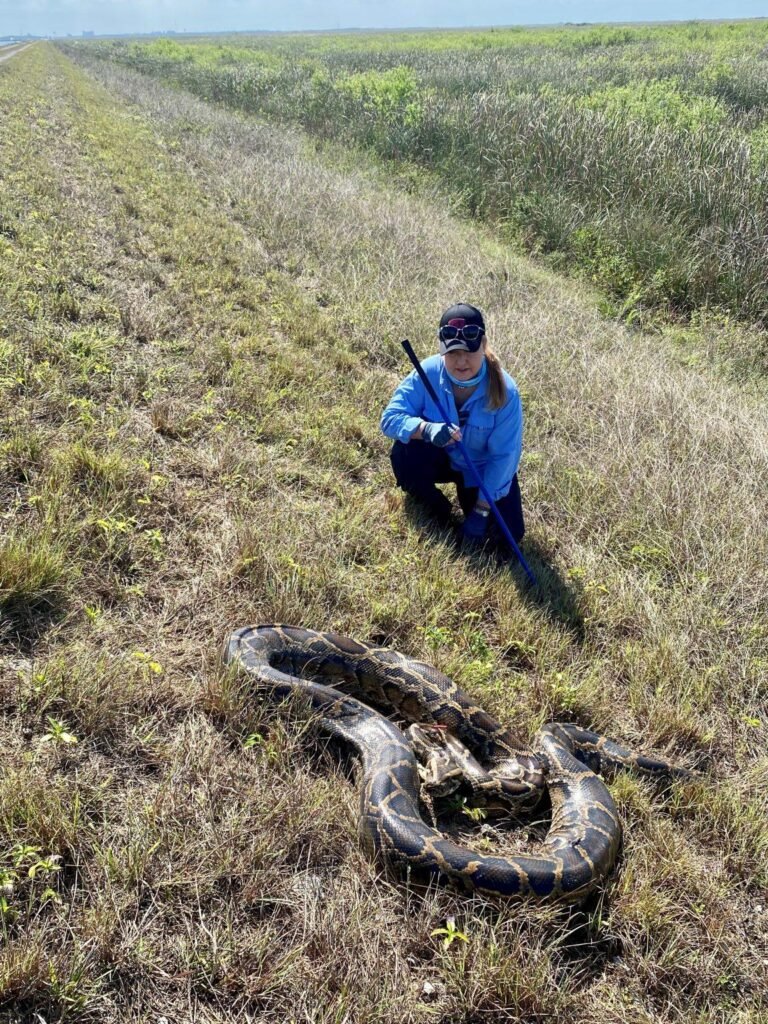
Scientists at the University of Florida have developed a digital PCR test capable of identifying genetic material from Burmese pythons, northern African pythons, boa constrictors and rainbow boas in water or soil samples. The technique is designed to help wildlife managers locate elusive snakes that are difficult to detect through conventional visual surveys.
Environmental DNA, or eDNA, consists of genetic material organisms leave behind in their surroundings. In controlled experiments, researchers placed a Burmese python in water and collected samples at different intervals to establish how much of its DNA could be detected. Field experiments also found python DNA in soil where a snake had been resting, including samples collected after the animal had left.
The technology addresses a major challenge in managing Burmese pythons. Traditional surveys have extremely low detection rates because the snakes are secretive and can remain hidden in dense wetlands. Research presented by the U.S. Geological Survey and University of Florida has shown that eDNA can provide a more sensitive way of determining whether pythons are present across large areas.
Researchers are also experimenting with artificial prey to draw the snakes out of hiding. High-tech rabbit decoys are designed to reproduce several cues associated with live prey, including movement, scent, vibrations and heat. The objective is to make pythons easier for wildlife teams to locate and remove from the environment.
Burmese pythons are native to South and Southeast Asia but have been established in Florida for decades. The Florida Museum says the species is currently established in the southern Florida peninsula from Lake Okeechobee southward, including the Everglades and Florida Bay.
The snakes pose ecological concerns because they are large constrictors capable of consuming a wide variety of birds and mammals. Their elusive behavior has made population monitoring and removal difficult, increasing interest in technologies that can detect their presence without requiring researchers to physically encounter them.
The Florida effort is part of a broader shift toward using molecular detection, remote sensing and engineered tools alongside conventional wildlife management. Researchers hope these methods can help identify invasive populations earlier, target removal operations more efficiently and improve monitoring of the Everglades ecosystem.
Sources: University of Florida IFAS, U.S. Geological Survey, Florida Museum, Times of India and WSVN.