
Astronomers directly detected radio emission from a planet outside our solar system for the first time. It revealed the planet’s magnetic field strength.
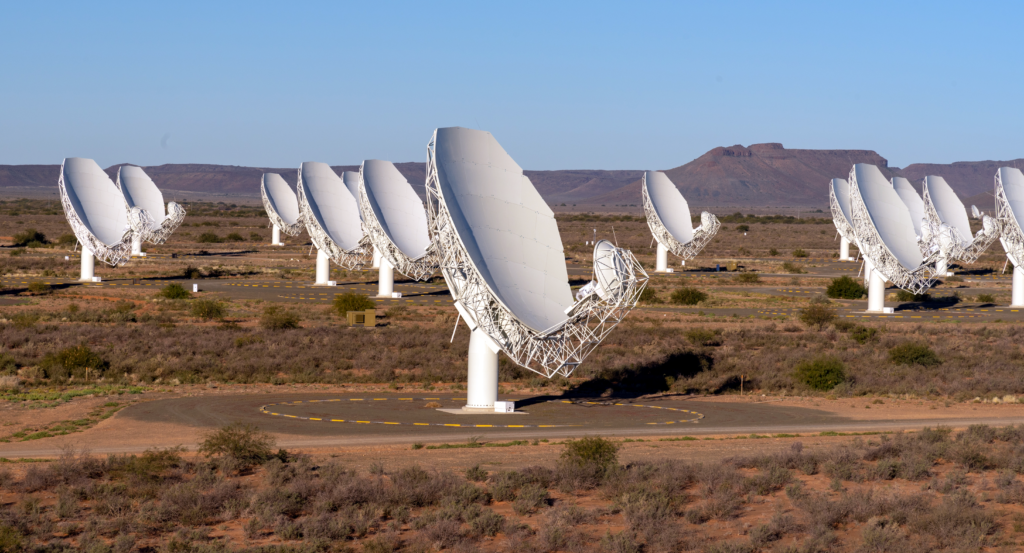
Astronomers have directly detected radio emission from a planet outside our solar system for the first time, a discovery scientists say opens a new way to study distant worlds. A research team led by Kevin Ortiz Ceballos of the Center for Astrophysics at Harvard and Smithsonian used South Africa’s MeerKAT radio telescope array to trace repeating bursts of radio signals to Beta Pictoris b, a gas giant roughly 64 light-years from Earth.
The team initially could not determine whether the radio waves originated from the planet or its host star, Beta Pictoris, an A-type star roughly 23 million years old. By layering radio images against a precise celestial reference frame tied to nearby quasars, the researchers confirmed the signal’s position matched the planet rather than the star. Beta Pictoris b, first discovered in 2008 and estimated at 9 to 13 times the mass of Jupiter, orbits its star at roughly eight times the distance between Earth and the sun. Scientists identified the emission as auroral radio bursts, generated when charged particles interact with a planet’s magnetic field and atmosphere, similar to the process that produces auroras on Earth and Jupiter.
The detection allowed researchers to calculate the planet’s magnetic field strength directly for the first time in any exoplanet, estimated at a minimum of 1.25 kilogauss, more than a thousand times stronger than Earth’s own magnetic field. Suzanne Aigrain, a professor of astrophysics at the University of Oxford who was not involved in the research, said scientists had sought radio signals from exoplanets for years, with only tentative, indirect evidence found previously, calling this the first truly convincing direct detection. The researchers said the method could be applied to at least seven other directly imaged giant planets across five additional star systems within about 147 light-years of Earth, potentially allowing astronomers to measure magnetic fields across a broader range of distant worlds. The findings have been posted to the arXiv preprint server and have not yet completed formal peer review.
This report is based on information from Live Science, Phys.org, ScienceAlert, Sci.News and Techlicious.