
|
Getting your Trinity Audio player ready...
|
Trinidad and Tobago’s government has declared support for U.S. military action against Iran, citing nuclear security concerns, while the move draws criticism locally and underscores the Caribbean nation’s evolving foreign policy stance amid escalating Middle East conflict.
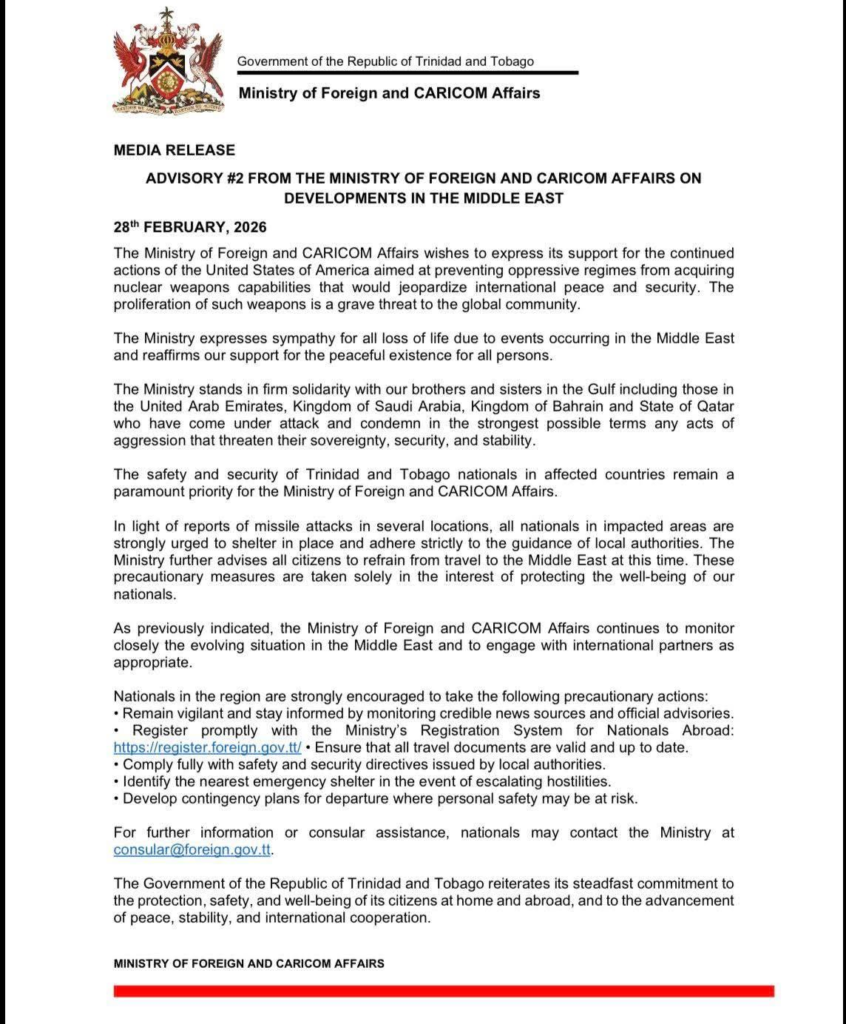
Government declares support for U.S. action
The Government of Trinidad and Tobago has publicly backed the United States following its military strike on Iran, aligning the Caribbean nation with Washington during one of the most serious Middle East confrontations in recent years.
In an official advisory, the Ministry of Foreign and CARICOM Affairs expressed support for U.S. actions aimed at preventing “oppressive regimes from acquiring nuclear weapons capabilities that would jeopardize international peace and security.”
The government also expressed sympathy for loss of life and reaffirmed concern for stability and safety across the Gulf region.
The U.S. and Israel launched a major coordinated attack on Iranian targets, triggering retaliatory missile and drone strikes across the region and significantly escalating geopolitical tensions.
Nationals safe as conflict intensifies
Officials confirmed that Trinidad and Tobago nationals living in affected Gulf states, including Qatar, Saudi Arabia, and the United Arab Emirates, have not been reported injured or killed.
The Ministry has urged nationals to remain indoors, monitor official advisories, and prepare contingency plans in case the conflict worsens.
Authorities have also maintained communication channels with citizens abroad to monitor their safety and provide assistance if necessary.
Criticism and political backlash
The government’s position has drawn criticism from political opponents, who warned that publicly backing military action without United Nations authorization could harm Trinidad and Tobago’s diplomatic reputation.
Critics described the move as a departure from the country’s traditional diplomatic neutrality and raised concerns about international law and regional relations.
The decision reflects broader geopolitical shifts, with Trinidad and Tobago increasingly aligning with U.S. security and diplomatic priorities.
Economic and global implications
Economists say the conflict could have both positive and negative effects on Trinidad and Tobago’s economy.
Higher oil prices could increase government revenues through exports, but higher fuel import costs and shipping expenses could offset those gains and increase inflationary pressure.
Analysts warn that prolonged conflict could disrupt global energy markets, international trade, and economic stability worldwide.
A defining foreign policy moment
Trinidad and Tobago’s backing of the U.S. represents a significant moment in its foreign policy direction, placing the country firmly within Western diplomatic alignment during a major international crisis.
As tensions continue to escalate, the government faces the challenge of balancing diplomatic alliances, economic interests, and national security concerns.
Sources: Ap News, TT Guardian, TT Express, Ministry of Foreign Affairs