
WASA bans hosepipe use on private gardens and cars from Monday. El Niño has cut raw water supply.
Trinidad and Tobago’s Water and Sewerage Authority (WASA) has banned the use of hosepipes and similar equipment to water private gardens or wash private vehicles nationwide from 12:01 a.m. Monday, Nov. 16, saying the El Niño weather pattern has reduced raw water availability at source. The WASA water restrictions remain in effect until further notice.
Under the restrictions, customers may not use WASA-supplied water drawn through hosepipes, sprinklers, pressure washers or similar apparatus to water private gardens or wash private motor vehicles, WASA said in a release, as reported by the Trinidad Express. WASA’s public notice cites section 49(1) of the Water and Sewerage Act, Chapter 54:40. The notice graphic also lists outdoor features such as fountains, waterfalls and water displays among the uses covered.
WASA said increased patrols will monitor compliance for as long as the restrictions last. Authorized officers, on production of authenticated documents, have the general power to enter any premises supplied with water at reasonable hours to check for waste or misuse, according to the release. Anyone who breaches the prohibition is liable to a fine on summary conviction. The reports reviewed by Aurax News did not state the amount of the fine.
The release also reminded owners and occupiers that they are responsible for keeping water fittings in good condition so that water supplied to the premises is not wasted, misused, unduly consumed or contaminated.
Why the WASA water restrictions are in place
WASA said the Trinidad and Tobago Meteorological Service advised that El Niño conditions are established in the tropical Pacific. According to the release, the Met Service’s August 2026 assessment indicated an 80 percent chance of El Niño strengthening between August and October, with a likely peak between November 2026 and February 2027. In Trinidad and Tobago, the pattern is associated with reduced rainfall in the latter part of the wet season, and drier conditions are expected to continue into the 2027 dry season.
Wet-season rainfall normally replenishes the country’s raw water sources, WASA said. With less replenishment expected this year, the authority said it is acting early to stretch available supplies and protect water for drinking, cooking, sanitation and hygiene, as well as for schools, health facilities and other essential services.
WIC News reported that the Caribbean Climate Outlook Forum has also forecast that El Niño conditions will continue through the height of the Caribbean dry season in March 2027. WIC News noted that the measures represent a shift from earlier expectations, citing a Met Service forecast in December of a wet start to the 2026 dry season and WASA reports in January that its four main reservoirs were at or near full.
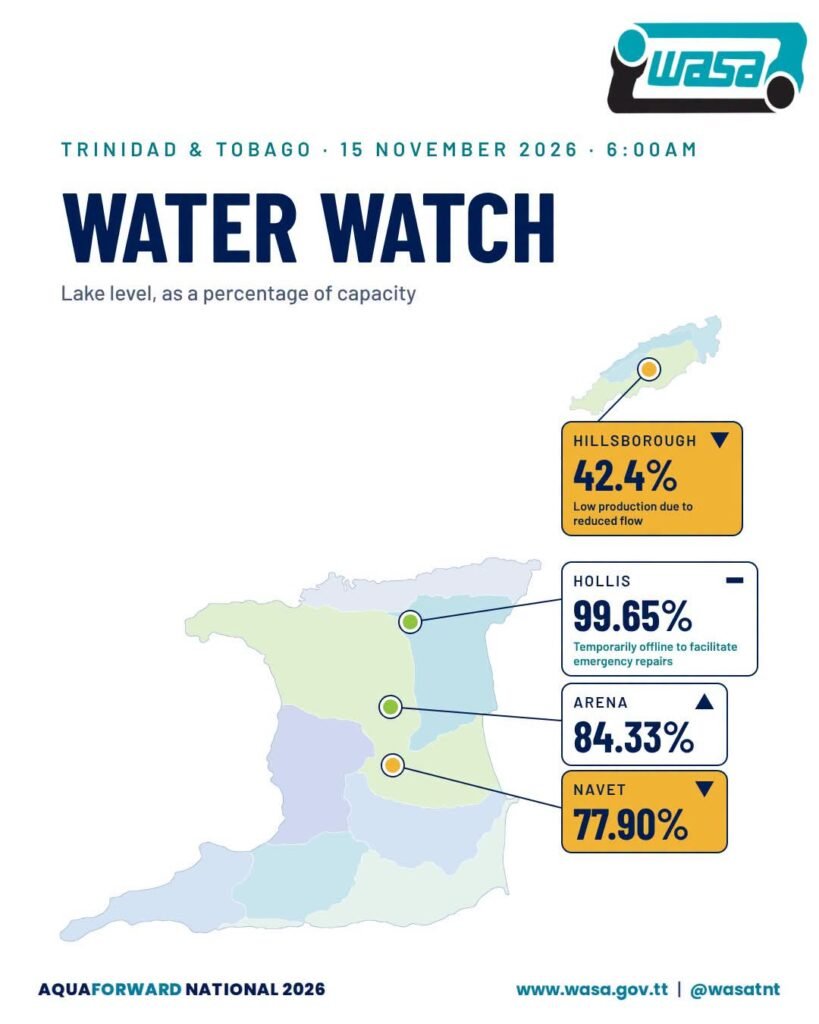
WASA’s Water Watch update for 6 a.m. Sunday, Nov. 15, gave lake levels as a percentage of capacity. Hollis stood at 99.65 percent, Arena at 84.33 percent, Navet at 77.90 percent and Hillsborough in Tobago at 42.4 percent. WASA said the Hollis plant was temporarily offline to facilitate emergency repairs, and described low production at Hillsborough due to reduced flow. The update showed Arena rising and Navet and Hillsborough falling.
In a post on Sunday, WASA said El Niño is still with us and urged the public to follow the hose ban and use water wisely.
The restrictions form part of AquaForward, a national water resilience initiative launched in August 2026 and supported by the Ministry of Public Utilities and the Met Service, according to the Express. WASA asked customers to repair household leaks promptly, use a bucket rather than a running hose for any permitted washing, fit taps and showers with low-flow devices and report leaks on the authority’s network as soon as they are seen.
WIC News reported that WASA introduced a similar measure in Tobago on Oct. 29, citing a potential severe shortage ahead of Tobago Carnival. The restrictions announced Sunday apply across both islands.
It is not clear from the reports reviewed how long the restrictions will remain in place, which uses beyond gardens and private vehicles are covered, or whether commercial and public users are affected. Aurax News will update this article when WASA provides further guidance.