
A third US carrier is in the Middle East. Iran says it will not wait to be attacked.
WASHINGTON — A third US aircraft carrier has reached the Middle East, a US official said, as Iran warned it will not wait for Washington to attack first and President Donald Trump weighs his next steps in the war with Tehran.
The USS Theodore Roosevelt entered the area covered by US Central Command on Sunday, Nov. 15, a US official told Al Jazeera. The Times of Israel, citing a report by Axios and Channel 12 journalist Barak Ravid that also cited a US official, said the carrier joins the USS George Washington and USS George H.W. Bush, bringing the number of US carrier strike groups in the region to three. The reports cited an unnamed official, and none of the sources reviewed carried an on-record Pentagon statement.
Third US aircraft carrier joins a large buildup
The Times of Israel reported that the US naval presence in the region now includes more than 20,000 sailors and Marines and hundreds of aircraft, along with the USS Boxer amphibious readiness group. It said the Pacific-based George Washington had moved to the Middle East to relieve the long-deployed USS Abraham Lincoln, and described the war with Iran as stretching past seven months.
The Jerusalem Post reported that a similar three-carrier deployment took place in April, the first time three US carriers operated in the region at once since the 2003 Iraq War. It said it remains unclear how long all three will stay. The Roosevelt had been expected to replace one of the two carriers already there, but US officials said all three could remain if necessary.
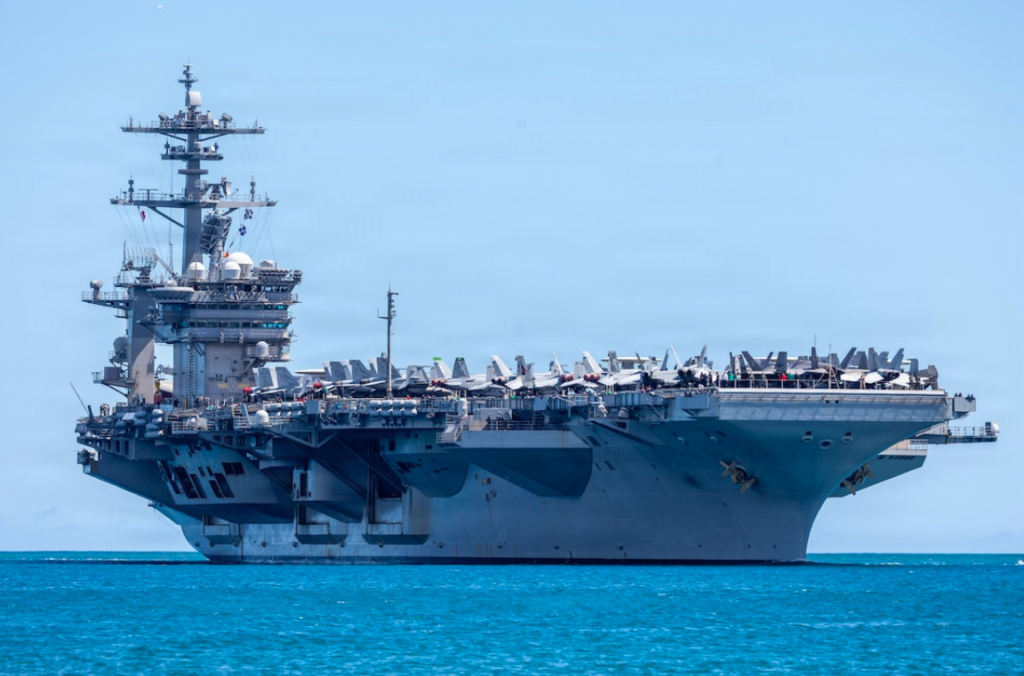
The Nimitz-class aircraft carrier USS Theodore Roosevelt returns to Joint Base Pearl Harbor-Hickam on July 28, 2026. (US Navy photo by Mass Communication Specialist Seaman Mark Bergado)
Iran’s warning
Kazem Gharibabadi, Iran’s deputy foreign minister for legal and international affairs, said Tehran “will not wait for the US to attack first,” Al Jazeera reported. He suggested Washington might be using diplomacy to buy time to prepare for another attack. The reports reviewed did not include a US response to his remarks.
The Wall Street Journal reported Sunday that US intelligence agencies estimate Iran still has between 1,500 and 2,500 missiles despite extensive US and Israeli strikes, the Jerusalem Post said. Officials described the estimate as low-confidence because it is difficult to determine how many missiles remain operational or in storage.
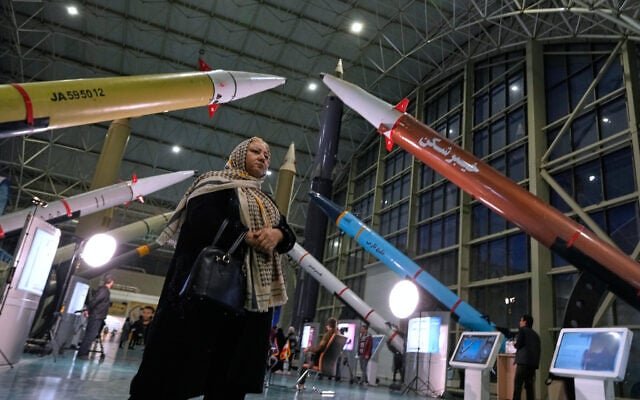
A woman walks past missiles at a permanent exhibition of the National Aerospace Park of the Revolutionary Guard outside Tehran on Nov. 9, 2026. (AP Photo/Vahid Salemi)
Trump weighs options ahead of Asia trip
The Jerusalem Post reported that no new large-scale US strike campaign against Iran has been announced. It said Trump has told senior advisers he may refrain from ordering more strikes unless Iran or the Iran-backed Houthis launch new attacks against American interests. Saudi Crown Prince Mohammed bin Salman and Turkish President Recep Tayyip Erdogan have urged him to avoid another round of escalation, while Israeli officials have continued pressing Washington to consider renewed operations against Iran, according to Reuters as cited by the Post.
Trump is scheduled to leave Washington on Monday for a trip to Asia, the Post reported. He is due to join meetings with Southeast Asian leaders in Manila on Tuesday and travel to Shenzhen, China, on Wednesday. On Thursday he is to attend the Asia-Pacific Economic Cooperation summit and hold a bilateral meeting and working lunch with Chinese President Xi Jinping. Toward the end of the visit, he is also expected to take part in a trilateral summit with Xi and Russian President Vladimir Putin.
The White House confirmed to the Post that Iran will be among the topics discussed, alongside the possibility of reducing the three countries’ nuclear arsenals. Senior administration officials cautioned that they do not expect the first trilateral meeting to produce a nuclear arms control agreement, with one calling it “the entry point, the first conversation.” Trump is not scheduled to hold a separate bilateral meeting with Putin, and officials said Ukraine will not be part of the trilateral agenda.
What happens next
The Jerusalem Post said the military buildup and Trump’s diplomacy in China underscore two options still open to the White House: maintaining military pressure on Tehran while exploring arrangements with other major powers. How long the three-carrier presence will last, and whether Washington will resume large-scale strikes, remain open questions in the reports reviewed.
This report draws on coverage by Al Jazeera, The Jerusalem Post and The Times of Israel, which cited US officials, Axios, the Wall Street Journal and Reuters.