
Proposed police development funding rises to $230.5 million in the 2027 budget. Specialist units see the sharpest rises.
PORT OF SPAIN, Trinidad – Development funding for the Trinidad and Tobago Police Service is set to more than triple to $230.5 million in 2027, according to the Draft Estimates of Development Programme and the Public Sector Investment Programme. The estimates were presented after Finance Minister Davendranath Tancoo outlined a $63.368 billion budget in Parliament on Monday. They come as the Government prepares special operations in designated divisions and promises tougher policing.
The total includes $186.1 million through the Consolidated Fund and $44.4 million through the Infrastructure Development Fund. That is about $159.7 million, or 225 percent, more than the combined revised 2026 provision of $70.9 million, and about $56.2 million, or 32 percent, above the $174.3 million originally allocated for 2026.
Specialist units get some of the largest increases. The Special Operations and Counter Home and Business Invasion Task Force receives $12 million, up from a revised $825,000. Establishing a Coastal and Riverine Patrol Unit rises from $914,000 to $10 million, and upgrades to the Air Support and Drone Unit receive $5 million, up from $1.6 million. A separate Special Anti-Crime Operation Unit gets about $4.95 million, compared with $1.05 million.
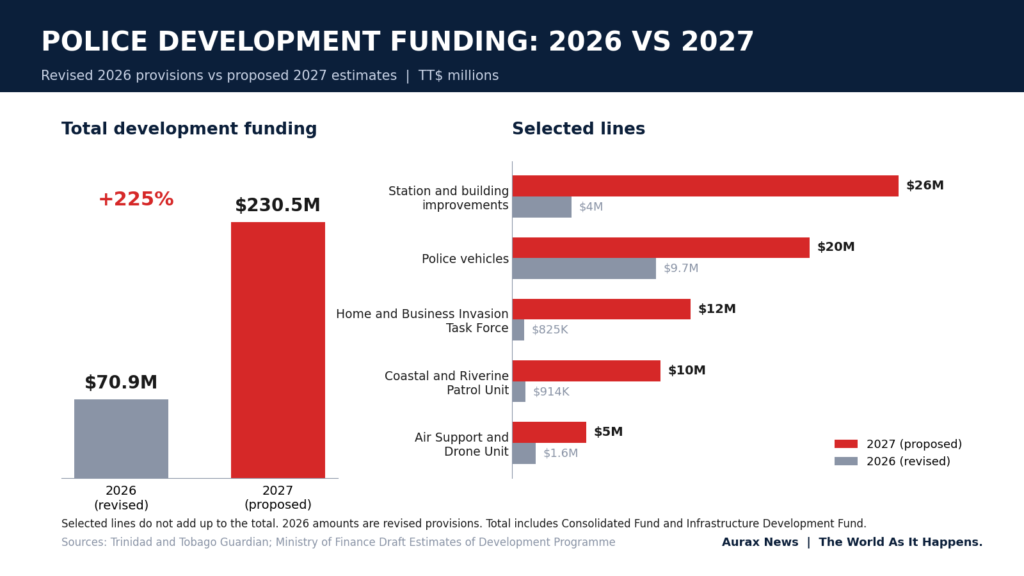
Infrastructure and equipment also rise. Improvement works to police stations and buildings receive $26 million, up from $4 million, with $3.5 million more for Tobago, $5 million for works at the Ste Madeleine police station and $1.5 million for the Las Lomas station. Police vehicles receive $20 million, up from about $9.7 million. Other allocations include $14 million for the service’s computer system, $7 million for Police Academy works, $4.8 million for training, $5.3 million for a canine facility in Caroni and $4.2 million for detention-cell upgrades. The equipment funding includes money for body-worn cameras, but the estimates do not say how much or how many cameras.
Prime Minister Kamla Persad-Bissessar has said cameras must be worn during special operations, though the Special Operations Act requires their use only where practicable. Criminologist Dr. Malisa Neptune-Figaro called the increases a significant investment in capacity and said the key test would be whether the money produces faster responses and stronger investigations. She called for clear, public targets, including how vehicles will be acquired and deployed and when projects will be finished. The Guardian said it sent questions to Police Commissioner Allister Guevarro on targets and timelines and that he had not responded by press time.