
The U.S. has imposed an outright ban on Canadian imports, an unusual step in modern trade policy. It marks a serious escalation between longtime allies.
The United States imposed an outright ban on nearly $1 billion worth of Canadian imports early Tuesday, a rare and aggressive step in modern trade policy that marks the sharpest escalation yet in President Donald Trump’s trade war with America’s closest ally and largest two-way trading partner. The restrictions, which took effect just after midnight, bar the import of most Canadian alcoholic beverages, dairy byproducts and larger motorcycles, and follow proclamations Trump signed Sept. 8 accusing Canada of unfairly discriminating against U.S. commerce, according to the Associated Press.
Villanova University international business professor Jonathan Doh said he could not recall a comparable modern instance of an outright import ban between major trading partners, describing such measures as “extremely unusual as an artifact of trade policy.” The bans target Canadian beer, wine, cider, whisky, vodka and other spirits, along with whey products, molasses, nonalcoholic beer and motorcycles with engines larger than 800 cubic centimeters. Trade policy analyst Jacob Jensen of the American Action Forum estimated the measures cover roughly $967 million in Canadian goods based on 2025 trade data, with alcoholic beverages accounting for about 87% of that total. The alcohol restrictions follow earlier moves by several Canadian provinces to pull American liquor from store shelves in response to U.S. tariffs, a tit-for-tat pattern that has defined the dispute for months.
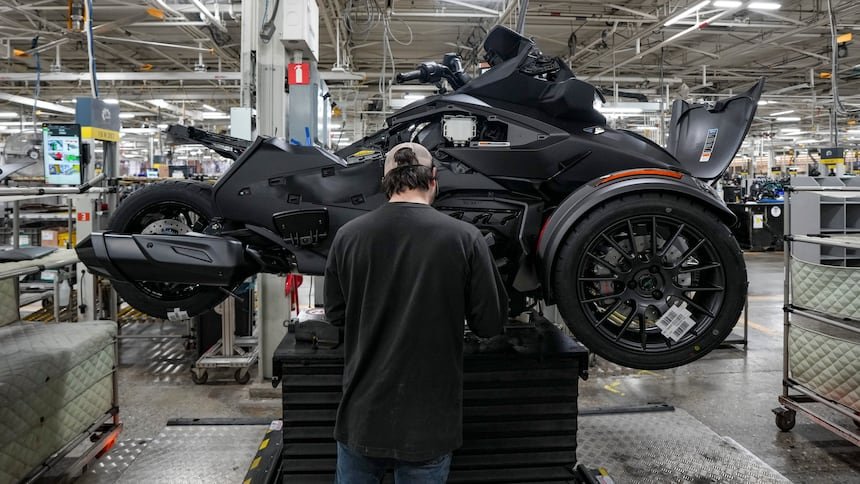
The measure is the latest in an escalating series of trade actions between the two countries. Earlier this year, the U.S. imposed 50% tariffs on roughly $20 billion of Canadian goods under a Depression-era trade law, and further tariff adjustments accompanying Tuesday’s bans extend to products including all-terrain vehicles, animal hides, paper, aluminum and furniture. The dispute has drawn warnings from industry groups on both sides of the border. The Dairy Farmers of Canada called the new whey restrictions “deeply concerning,” while U.S. trade data shows nearly half of the whey and modified whey America imported in 2025 came from Canada, a product increasingly in demand for its role in high-protein food manufacturing. Quebec-based Bombardier Recreational Products confirmed its Can-Am Spyder and Canyon motorcycles would be barred from U.S. import, though the company said the immediate impact would be limited since it had already completed most of this season’s production.
Despite the scale of the measures, some economists cautioned that the practical disruption may be limited. An analysis by Scotiabank’s Derek Holt found the dairy and motorcycle restrictions would likely be negligible, since Canada exports relatively little of either product to the U.S., though alcohol exports, valued at about $1.2 billion last year, represent a more substantial share. The ban covers a small fraction of the roughly $880 billion in annual two-way trade between the two countries. Even so, trade attorney Patrick Childress of Holland & Knight said the measure was unlikely to ease tensions between the two governments, and Trump signaled Monday that he had no plans to back down, even as he suggested Canada remained eager to reach a broader trade agreement.
The rupture marks a striking turn in a relationship long regarded as one of the world’s closest, between two countries that share the world’s longest international land border and decades of deep economic integration. Neither government has announced a timeline for renewed negotiations.
Sources: This report is based on information from the Associated Press, CBC News, CNBC and ABC News.