
|
Getting your Trinity Audio player ready...
|
World leaders gather in New York as wars, diplomatic tensions, economic pressures and challenges facing international institutions dominate the agenda.
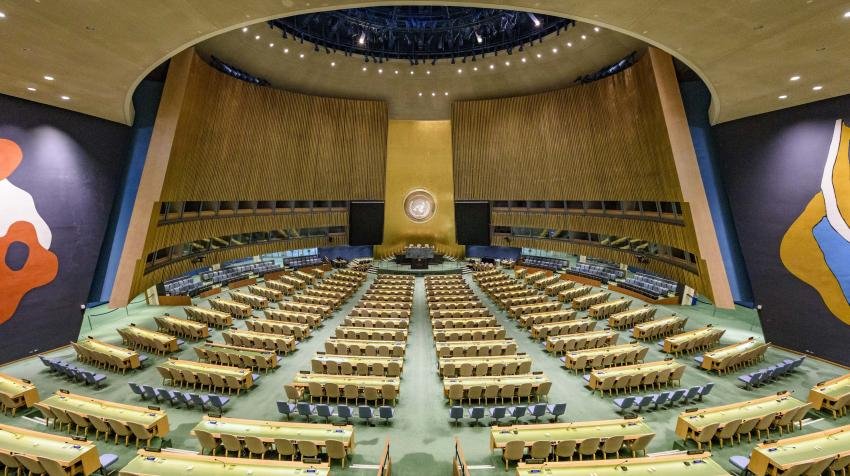
The 81st United Nations General Assembly’s high-level general debate opened Tuesday in New York, bringing together world leaders and senior officials for a week of diplomacy focused on conflicts, international security and global challenges.
The general debate runs from Sept. 22 through Sept. 26 and resumes Sept. 28, with representatives of the 193 U.N. member states invited to address the Assembly. Nearly 130 heads of state and government are expected to take the podium during the high-level portion of the meeting, according to Al Jazeera. The United Nations lists the broader high-level week as running through Sept. 29, with additional high-level meetings addressing issues including climate action, sea-level rise, pandemic preparedness and nuclear disarmament.
U.S. President Donald Trump is scheduled to address the Assembly on Tuesday after Brazil, following the traditional opening sequence in which Brazil speaks first and the United States, as host country, follows. Trump is also scheduled to hold a series of bilateral meetings with foreign leaders during the week as conflicts involving Iran and Ukraine remain central diplomatic concerns. Reuters reported that his agenda includes meetings with Ukrainian President Volodymyr Zelenskyy, British Prime Minister Andy Burnham, Gulf representatives and Venezuela’s interim leader Delcy Rodriguez.
The gathering comes as diplomats confront multiple conflicts and a broader debate over the effectiveness of international institutions. AP reported that officials arriving for the meeting describe a global environment marked by wars in Europe and the Middle East, instability, economic pressures and disputes over international law and diplomacy. The Russia-Ukraine war remains unresolved, while the conflict involving Iran has contributed to wider regional tensions and disruption to energy markets.
The U.N. is also dealing with questions about its own future role, including funding pressures and the forthcoming transition in its leadership. Secretary-General Antonio Guterres is serving the final months of his second term, which ends Dec. 31, and the Security Council is conducting an informal process to identify a candidate before making a formal recommendation to the General Assembly. The current field includes candidates from Costa Rica, Guyana, Ecuador, Argentina, Senegal and Uganda.
The Assembly’s 2026 theme is “Restoring trust, managing transformation: a United Nations that delivers for all.” Beyond the speeches, the week’s program includes discussions on climate action, development, rising sea levels, pandemic preparedness and racism, while artificial intelligence and international security are also expected to feature prominently in diplomatic discussions.
The meeting also highlights continuing disagreements over access to the United States for some Palestinian officials. Palestinian President Mahmoud Abbas is scheduled to address the Assembly by prerecorded video after the United States denied visas to Palestinian officials, a decision the United Nations has criticized as inconsistent with the obligations of the host country.
Sources: Information attributed to the United Nations, Associated Press, Reuters and Al Jazeera.